 random.directory
What is RandomX? The CPU proof of work, explained
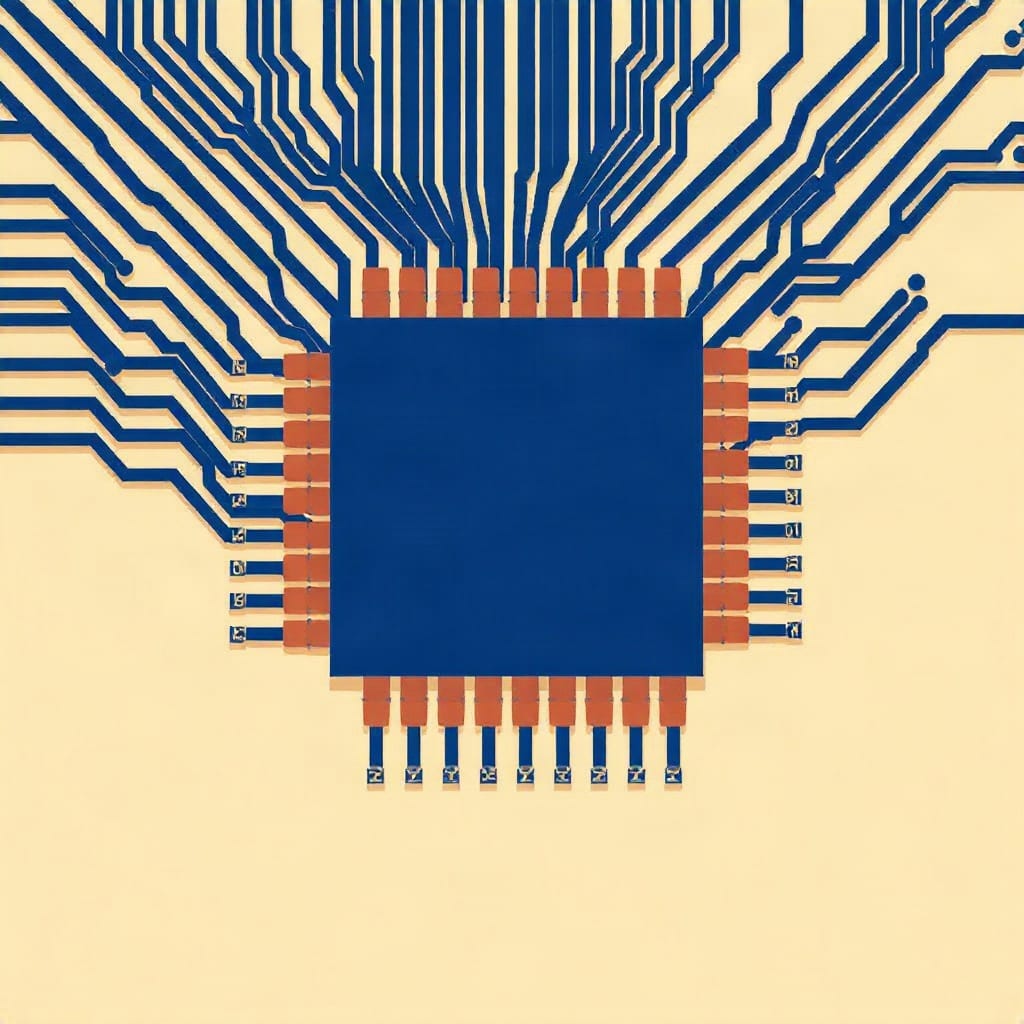
RandomX is a proof-of-work algorithm built for general-purpose CPUs. Each hash runs a set of randomly generated programs in a virtual machine whose instruction set — integer maths, floating-point maths and branches — is translated into the processor's own machine code on the fly. The outputs are folded into a 256-bit result with the Blake2b hash. It was designed as the proof of work for Monero, and Monero switched to it on 30 November 2019.
The point of the design is in its first sentence: the work is the kind of work a CPU already does well. A chip built only for RandomX would need most of what a CPU has — a floating-point unit, an instruction decoder, branch handling, large caches — so its advantage over the processor in an ordinary computer stays small.
How one hash is made
The key and the cache. Every hash depends on a key, and on Monero the key is the hash of a block in the chain. From the key, RandomX builds a 256 MiB cache with Argon2d: 262,144 blocks of 1 KiB, three passes, one lane. On Monero the key changes every 2048 blocks, about 2.8 days, with a delay of 64 blocks, about two hours, so a miner has time to prepare the next one.
The dataset. From the cache, RandomX expands a read-only dataset of 2080 MiB — a 2 GiB base of 2,147,483,648 bytes plus 33,554,368 bytes of extra — one 64-byte item at a time. All mining threads share it.
The scratchpad. Each thread has its own 2 MiB scratchpad, filled from the input with an AES-based generator. It is split in three levels that mirror a CPU's caches: the first 16 KiB, the first 256 KiB and the whole 2 MiB.
The programs. The virtual machine runs 8 programs per hash, each of 256 instructions in RandomX v1, and each program loops 2048 times. Every loop reads the scratchpad and one 64-byte item of the dataset, at an address that is only known when the previous loop has finished — which is what makes the dataset impossible to skip.
The result. The scratchpad is hashed with AES, and Blake2b turns what is left into the 256-bit hash that is compared with the network's target.
Fast mode and light mode
RandomX can run in two modes that give the same results. Fast mode builds the whole 2080 MiB dataset once for each key and reads it for every hash; it is the mode for mining. Light mode keeps only the 256 MiB cache and works out each dataset item when it is needed, which is much slower; it is meant for checking a proof, not for producing one. The memory guide has what that means for a machine.
What a CPU needs for it
The RandomX README lists what efficient mining asks of a processor: a 64-bit architecture, an IEEE 754 floating-point unit, hardware AES (AES-NI on x86, the cryptography extensions on ARMv8), 16 KiB of L1, 256 KiB of L2 and 2 MiB of L3 cache per mining thread, support for large memory pages, and at least 2.5 GiB of free RAM per NUMA node. By its own count, most Intel and AMD processors made since 2011 qualify.
Memory speed matters as well as size. The README puts DDR3 at about 1500 to 2000 hashes a second per memory channel and DDR4 at about 4000 to 6000, depending on frequency and timings, so a fast processor on one channel waits on its memory.
The audits
Between May and August 2019, before Monero switched, RandomX was audited by four independent teams: Trail of Bits, X41 D-SEC, Kudelski Security and Quarkslab, coordinated by OSTIF. None found a critical vulnerability; several changes to the algorithm and the code were made because of them. Arweave, an early adopter of RandomX, paid for the first audit, and donations from the Monero community paid for the other three.
What came next
In March 2026 a second version of the algorithm was released, with longer programs and AES inside the main loop; Monero has not switched to it yet. The RandomX v2 guide has the changes and where the switch stands, and the variants guide has the versions other coins run.
What is RandomX? The CPU proof of work, explained: questions
Who created RandomX?
RandomX was designed by the developer known as tevador as a proof of work for Monero, and its reference code is published in the tevador/RandomX repository on GitHub. Monero switched to it on 30 November 2019.
Is RandomX ASIC-resistant?
It is designed to keep the advantage of specialised hardware small, not to make such hardware impossible. A chip for RandomX has to carry most of what a CPU carries — a floating-point unit, branch handling, large caches and fast memory — so it ends up much like a CPU. The README adds that the key must change and must not be chosen by the miner for that to hold.
Can RandomX be mined in a web browser?
Not efficiently. The README calls web mining infeasible: the dataset needs more than 2 GiB of memory, and neither JavaScript nor WebAssembly supports the directed rounding of floating-point operations that RandomX uses.
Source: RandomX README and specification (tevador/RandomX on GitHub) checked against the source
More RandomX guides

RandomX v2: what changes and when Monero switches
RandomX v2, released in March 2026, makes each hash about 53% more work — longer programs, AES in the main loop, a rarer rounding change and a deeper prefetch — for a small loss of hashrate. Monero has not switched yet: the change waits for a hard fork with no date set.

RandomX variants: rx/0, rx/2, rx/wow, rx/arq and more
RandomX is a family: Monero's rx/0 and the coming rx/2, and variants for Wownero, ArQmA, Graft, Safex and YadaCoin, each with its own salt and some with smaller scratchpads or shorter loops. What each RandomX variant changes, read from XMRig's source.

How much memory does RandomX need?
RandomX needs 2080 MiB of shared memory to mine in fast mode, 256 MiB to verify in light mode, and a 2 MiB scratchpad for every mining thread. Where each figure comes from, what huge pages do for it, and how much free RAM a machine needs in practice.